The sea has always been the refuge of those fleeing. Water keeps people alive. And everyone has their own story with the sea—seeing in it what they lack.
I don’t remember ever seeing the sea of Beirut as a place to breathe. Instead, the sea of Adloun, a coastal village in the south, was my only refuge—until reaching it became dangerous during this war. So I replaced it with Beirut’s sea, which has now become a shelter for hundreds of displaced people.

Before the war, I used to go there every day. The Corniche road was crowded with people, birds, and fishermen—especially after the hours of Iftar. At dawn on March 2, 2026, the same scene repeated itself, not because people had come during the hours of suhoor, but because the waterfront from Beirut’s seafront to Ramlet al-Baida had filled with a massive human strip fleeing the airstrikes that had begun to fall on Beirut’s southern suburbs, the villages of the south, and later the Bekaa.
Hours after the first airstrikes, my first conversation was with Adnan, who had left his home after several calls from his children about the jellyfish that had invaded the shore.
“Usually they come at the end of the season. Strange. I live near the sea in Tyre—we’re used to them. But the jellyfish is harmful in every sense of the word.”

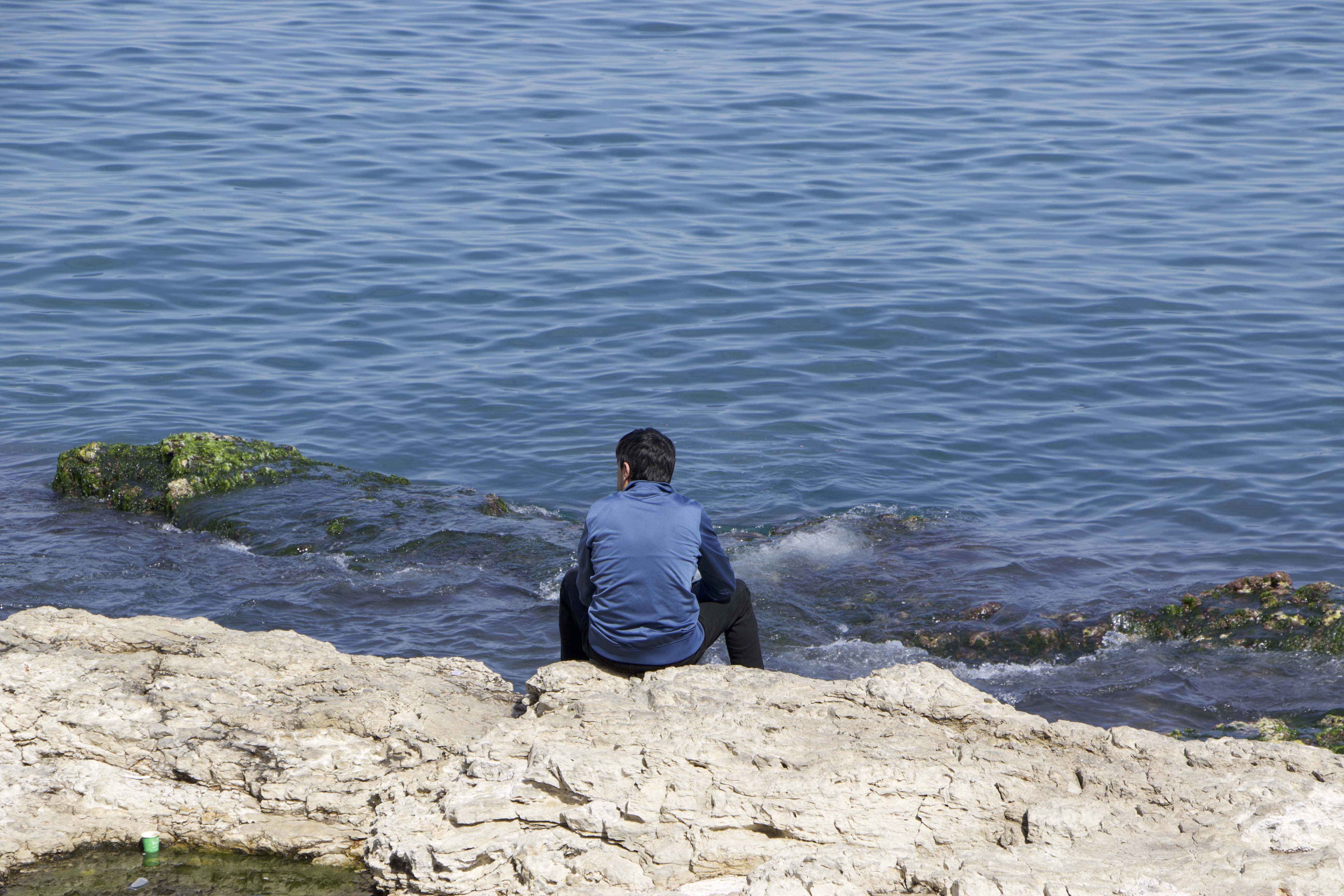
I return to the Corniche every day, as if entering the homes of hundreds without permission. They are exhausted by visits from foreign journalists and the cameras that watch them, yet they do not hesitate to tell the stories of those homes.
Tents fill the Corniche for those who managed to sleep inside them, while others lie on the ground, on the few wooden benches available, or on car seats that have turned into homes—missing only a bathroom.

A Syrian displaced person from the southern suburbs, who has been living in his friend’s car since the beginning of the war, explains the hardship of having no bathrooms:
“Our situation is very bad. Even for coffee—if you’re not a customer they won’t let you use the restroom. Women can’t go in. Do you think they’ll let us young men in? We wait until night, until it’s completely dark, then we go down to the rocks.”

On the same bench he had fled to during the previous war in September 2024, Ali, from the Bekaa city of Baalbek, sits facing the sea near the Raouche Rock, smoking his shisha the whole time and offering passersby a “little cruise” in the sea aboard his small boat, which he brought in hopes of restoring some source of income.
A woman says to him in surprise:
“A boat ride in the sea now?”
He replies laughing:
“Well, the war keeps going. This might change the mood.”

Hussein, nicknamed “al-Khayyami” after the border village of Khiam, fled to the Corniche with his five children, his wife, and her mother, finding a small corner that he changed after two days because of the many rats that infest the seaside rocks and pavements.
I met him as he was placing a blanket over the railing of the shore to soften the force of the wind and the spray of water as the high waves crashed against the rocks and the wall behind him.
In a single week, Hussein sought refuge on the shore twice. He decided to return home to escape the cold of the sea, then fled again from the threat of bombardment, even forgetting the bag of clothes he had been carrying. That, he says, is his only regret in this war.
Hussein refuses to speak in front of the camera or behind it:
“Right now I’m the most miserable person in the world. What do you want me to say? I fled the southern suburbs—who would have said that today I’d be in Ain al-Mreisseh (the seaside Corniche), sitting on a blanket?”